How to Enter Recruiting Season With Your Eyes Open

Most students approach recruiting season the same way they approach a difficult exam: study hard, perform well, get the result. But recruiting isn't an exam. It's a matching process. And the biggest mistake students make isn't failing to impress recruiters. It's not knowing what they're actually looking for before the process begins.
If you’re mid-process or just finished, this is still worth reading because the triangle applies at every stage, including deciding whether to accept.
After years of working with professionals across industries, watching smart, driven people end up in roles that drain them within two years, I've come to a simple conclusion: the students who thrive in their careers long after recruiting season are not always the ones who performed best in interviews. They're the ones who chose well before they ever walked into the room.
The Career Triangle, the framework at the heart of The Career Remix, exists precisely for this moment. It asks three questions that recruiting season rarely asks you to answer: Are you Ready? Are you Willing? Are you Able?
Let's apply them.
Before You Apply Anything, Apply the Triangle
The Career Triangle has three corners that must align for a career to work, not just on paper, but in practice.
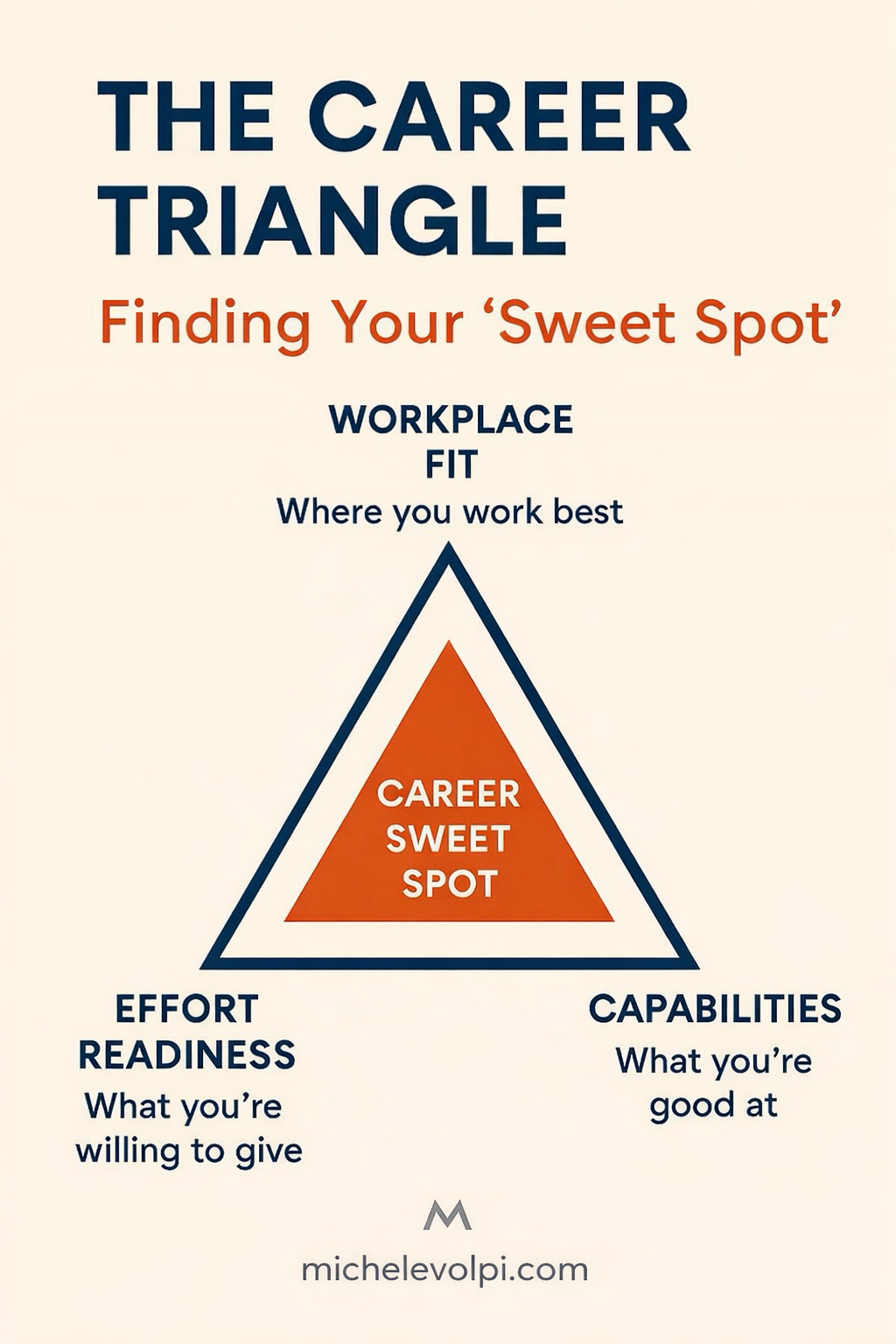
Ready refers to your effort readiness: what you are genuinely prepared to give. Not what sounds impressive in an interview, but what you can actually sustain. Are you ready to work 80-hour weeks in a demanding transactional environment? Are you ready to travel Monday through Thursday for your first three years? Are you ready to live on equity-only compensation for 18 months?
Willing refers to workplace fit: the environments, cultures, and dynamics that bring out your best or don't. Are you energized by hierarchy and execution, or by collaboration and ambiguity? Do you thrive with frequent feedback or with autonomy? Would you rather solve one problem deeply or advise across many?
Able refers to your hardwired capabilities: the natural traits, soft skills, and cognitive tendencies that you bring to any role regardless of where you studied. Attention to detail. Structured thinking. Empathy. Resilience under pressure. Accountability. These are not things you demonstrate on a CV but they determine whether you perform.
When these three align, you hit what I call the career sweet spot: a state where your effort is sustainable, your environment is supportive, and your natural strengths are actually being used. When they don't, the triangle breaks and the breakdowns have names. Too much effort with no cultural fit leads to burnout. Great capabilities in the wrong environment leads to disengagement. A perfect culture without a capability match leads to underperformance.
Recruiting season is the moment to diagnose your triangle before someone else's process does it for you.
Know What Each Career Actually Demands
One of the most persistent problems I see with students entering recruiting is that they pursue paths based on reputation, not reality.
Investment banking and management consulting are both elite, both demanding, and both treated as interchangeable by students who haven't looked carefully at what they actually require.
They are not interchangeable.
Investment banking, run through the Ready–Willing–Able lens, demands extreme effort readiness: 80–100 hours per week, limited personal autonomy, and a technical grind in the early years with limited client exposure. The culture is hierarchical, precision-oriented, and top-down. The capabilities it rewards are analytical, detail-focused, and execution-oriented. If you are competitive, pragmatic, and genuinely energized by performance under pressure, that triangle can click into place. If you're optimizing for prestige while secretly needing collaboration and intellectual variety, it won’t, regardless of how well you interview.
Management consulting demands a different triangle entirely. The workload is still intense, but the culture is more collaborative, the feedback culture more coaching-oriented, and the work fundamentally structured around hypothesis-driven problem solving and client communication. It rewards curiosity, adaptability, and people skills as much as analytical rigor. The student who thrives there often looks very different from the one who thrives in banking, even if their GPAs are identical.
The same logic applies across every comparison: Private Equity versus Venture Capital, Startup Founder versus Scaleup professional, Corporate versus NGO. Each path has a different effort profile, a different culture, and a different capability demand. The students who navigate this well are the ones who have done the inside work before they start the outside process.
Seven Strategies That Actually Move the Needle
Beyond framework, here is what I recommend students do in the months before and during recruiting season.
Get clear on your direction before you communicate it.
Employers do not want candidates who seem desperate or scattered. They want candidates who show direction. That means being able to articulate, clearly and specifically, what you are looking for and why, not generically, but in a way that connects your strengths and interests to the role. Set career hypotheses: I think I would thrive in X role in Y industry because of Z. You don't need certainty. You need honest, considered thinking.
Build your personal brand around results, not credentials.
Your degree is your entry ticket, not your pitch. Tailor your resume to highlight projects and outcomes, not just roles. Use numbers wherever possible. Your LinkedIn headline should tell a story, not just list your school and major. Recruiters will look you up. Make sure what they find reflects a person who has already started thinking like a professional.
Earn real-world experience in any form you can.
Pro bono projects, student consulting engagements, case competitions, hackathons, freelance work. All of it counts. Experience, even unpaid (I know, it’s unfair and some of you can’t afford that), beats theory in every recruiting conversation. It also resolves the experience paradox: you need experience to get experience, and these vehicles are the bridge.
Build your network before you need it.
Between 70 and 80 percent of jobs are filled through connections. That means the most important conversations you will have during recruiting season are the ones that don't look like recruiting conversations: coffee chats, alumni calls, informational interviews. Be proactive, start early and make time for that. Approach these with genuine curiosity. Ask about people's paths, what they'd do differently, what skills they'd focus on. Ask, at the end of every conversation: Is there anyone else you think I should speak with? That one question compounds your network faster than any job fair.
Decode job descriptions rather than just reading them.
Learn to distinguish between what is essential and what is aspirational in a job posting. Due-diligence the employer as carefully as they will diligence you. Check for culture fit, not just role fit. The goal is not any job, it is the right job.
Invest in the skills that compound.
Data literacy, financial modeling, AI fluency, storytelling, structured communication — these are the skills that make you relevant now and adaptable later. The students who enter recruiting with a balanced skill stack, functional depth combined with the human capabilities that AI cannot replicate, have a first-mover edge that shows in every interview.
Stay mentally resilient across the process.
Rejection is structural, not personal. Some of the best candidates I know were rejected from the roles they eventually realized they did not actually want. Build a routine, track your progress, support the peers in your cohort who are also in the process. A strong mindset is not a soft consideration, it is the fuel that keeps your performance consistent across a recruiting season that can last months.
The Question Recruiting Season Won't Ask You
Here is the most important thing I can tell you before you start this process.
Recruiting will ask you to prove you are impressive. It will not ask you whether the role is right for you.
That second question is yours to answer and almost no one answers it with enough honesty before signing an offer. The result is that talented professionals spend two or three years in roles that look excellent on a LinkedIn profile and feel draining in daily practice. They get the credential without the fit. And then they come back to a version of this process, mid-career, trying to course-correct something they could have calibrated at the beginning.
The Career Triangle is not a framework for getting the best offer. It is a framework for choosing the right one.
Before you walk into your first interview, ask yourself: Am I ready to give what this role actually demands? Will I be energized or drained by this environment? Am I applying the capabilities that come naturally to me, or am I performing a version of myself that fits the job description?
If the triangle balances, go all in. If it doesn't, keep looking.
Your career sweet spot exists. Recruiting season is just the first chance to start finding it.