Do you have your “career triangle”?
Most career advice quietly assumes one of two things:
1. If you just work harder (be more “ready”), things will sort themselves out.
2. If you just build more skills (be more “able”), the market will reward you.
But the data – and real lives – tell a different story.
You can be hardworking and highly capable and still be burned out, disengaged, or quietly miserable. The missing piece is not more effort or more skills. It’s something deeper and more uncomfortable:
Do you actually want the kind of work, environment, and life you’re building?
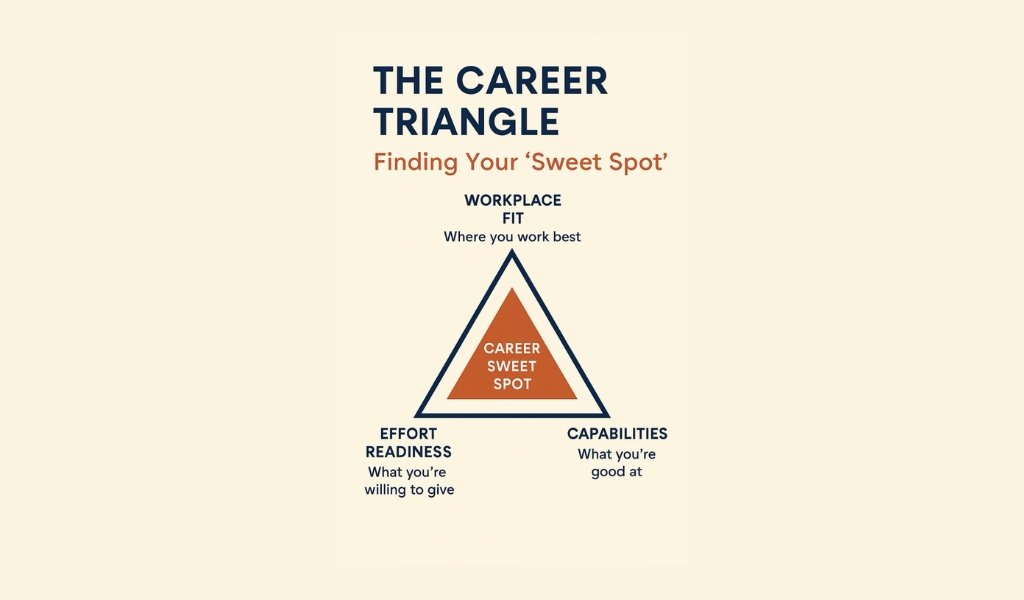
That’s the “Willing” leg of what I call the Career Triangle: Willing – Ready - Able.
• Willing = motivation, values, and environment fit
• Ready = effort, drive, resilience, follow-through
• Able = strengths, capabilities, and role fit
In my experience as a CEO, executive, and career mentor, these three legs together correlate far better with long-term career success than any one dimension alone.
But the sequence matters: You can’t sustainably be Ready or Able in the wrong direction.
It all starts with Willing.
The Evidence: Why “Willing” Comes First
1. Meaning and “calling” massively affect satisfaction and persistence
People tend to see what they do as a job, a career, or a calling. And those with a calling orientation report higher satisfaction and better overall well-being.
That “calling” isn’t necessarily some grand mission. It’s the sense that your work matters to you and aligns with your values and identity. In triangle terms: that’s Willing.
Without that, “Ready” becomes grind… and “Able” becomes underused or misused talent.
2. Fit predicts performance, commitment, and staying power
When people feel they fit, they show higher job satisfaction, stronger commitment, better performance, lower stress, and lower turnover.
Fit is essentially “Willing” made visible:
• I like how they work here.
• I agree with why we do what we do.
• This environment makes sense for who I am.
When that’s missing, even strong performers eventually check out or leave.
3. Engagement isn’t “nice to have” – it’s bottom-line critical
Global research on engagement shows that engaged teams are more productive and more profitable, with lower absenteeism and dramatically lower turnover. Some studies report up to 21–23% higher profitability and significantly less turnover in highly engaged groups.
And yet global engagement levels hover around 20–30%, meaning most people are not truly “Willing” in their current work.
If “Willing” is weak, “Ready” and “Able” never get to fully show up. You can’t sustainably pour effort into something you don’t believe in or feel connected to.
The Career Triangle: Ready – Willing – Able
Here’s the model I use in mentoring:
• Ready – Are you prepared to put in focused effort, handle setbacks, and keep going when things get hard?
• Willing – Do you actually want this work, in this environment, for reasons that matter to you?
• Able – Do your strengths, capabilities, and learning curve match what the role really demands?
All three matter. But in practice, the order is:
1. Willing – Find what energizes and motivates you.
2. Ready – Direct your effort where your motivation is real.
3. Able – Build and deploy capabilities where you have natural leverage.
Otherwise you get common but painful patterns:
• High Ready + High Able + Low Willing → high performer on the edge of burnout
• High Willing + High Able + Low Ready → dreamers who never quite ship
• High Willing + High Ready + Low Able → hard-working, motivated people stuck in the wrong game
The Three Levels of Fit: Career, Employer, Role
Most people look at fit in only one dimension at a time:
• Do I like this job title?
• Do I like this company?
• Is this an interesting sector?
But real sustainable fit requires alignment at three sequential levels:
1. Career Fit – Direction
Big question: Is this the right arena for me?
Here “career” doesn’t mean job title. It means the business world you choose to operate in. Because indie business, corporates, private equity, consulting, and entrepreneurial ventures each demand different instincts, tolerances, and ways of working.
These career arenas shape everything:
• Corporate careers reward navigation of structure, scale, process, stakeholders, and long-cycle impact
• Private equity and portfolio-company careers require intensity, execution under pressure, resilience, and turnaround orientation
• Consulting careers demand analytical sharpness, client management, adaptability, and comfort with constant change
• Indie business or entrepreneurial paths favor autonomy, risk appetite, broad problem-solving, and full ownership
• Scale-up or tech-growth environments mix entrepreneurial urgency with growing constraints
• Family-business ecosystems rely on trust, continuity, adaptability, and relational intelligence
Each arena has its own culture, pace, expectations, risk profile, and psychological demands.
Career Fit asks whether this arena matches your motivations, temperament, and definition of a meaningful working life.
If you choose the wrong arena, no amount of effort or capability will make the experience feel right. Choose the right one, and the rest of your decisions (employer, team, role) become dramatically clearer.
2. Employer Fit – Environment
Big question: Is this the right environment to do that work?
This is about:
• Culture (hierarchical vs. flat; aggressive vs. collaborative)
• Purpose (what the company is actually trying to achieve)
• Pace, pressure, and expectations
• Geography, hybrid vs. remote, travel intensity
• How decisions, recognition, and promotions actually work
Two people with the same career path (e.g., marketing) can thrive or fail completely depending on whether they’re in a startup, a family business, a global multinational, or a PE-backed turnaround.
That’s person–organization fit in the research and it strongly predicts attitudes, commitment, and retention.
3. Role Fit – Seat
Big question: Is this the right seat for me in this specific organization, right now?
Here we are at person–job fit:
• Are you using your top strengths most days?
• Are the problems you’re solving energizing or draining?
• Is your manager someone who unlocks you or boxes you in?
• Are you operating at the right altitude (strategic vs. hands-on vs. specialist)?
This is where “Able” lives: the match between what you are naturally good at and what the role actually demands, not just what’s written in the job description.
Honest Self-Assessment Is Only Half the Story
There’s a lot of advice about reflection and self-knowledge: journals, tests, strengths lists, personality inventories. These are useful – and I use them.
But there’s a dangerous assumption baked into much self-help:
“If I know myself well enough, the right path will appear.”
It won’t.
Because fit is relational.
You need two kinds of information:
1. Self-knowledge
• What truly motivates you (not what you think should motivate you)
• Where your effort flows naturally
• Where you learn faster than average
• The environments where you feel “lighter,” not heavier
2. World knowledge
• What a job actually looks like beyond the title
• How a company really operates beyond the careers page
• What a specific team is like beyond the glossy LinkedIn posts
Most people underinvest in the second bucket. They treat careers like online shopping: quick scan of the description, a couple of clicks, and then surprise when the package doesn’t match the picture.
The Due Diligence Most People Skip (And Employers Undervalue)
When you’re choosing a role, you’re not just accepting a job. You’re choosing:
• A daily environment
• A set of people and norms
• A version of yourself that will be reinforced or eroded over time
That deserves real due diligence:
• Talking to future peers, not just the hiring manager
• Asking, “What kind of person fails here?” as well as who succeeds
• Probing for how feedback, conflict, and mistakes are handled
• Understanding what “good performance” really looks like in year 1, 2, 3
• Looking for signs of burnout, constant turnover, or chronic reorgs
This is not paranoia. It’s rational risk management.
Why employers and headhunters often don’t help enough
There are structural reasons why you don’t always get the full picture:
• Headhunters are often incentivized to close the search, not optimize your 10-year fit.
• Hiring managers are under pressure to fill the seat, sometimes yesterday.
• Companies fear that too much transparency will “scare candidates away.”
Ironically, the research shows the opposite: when fit is high, companies get better performance, higher engagement, and lower turnover. All of which have direct financial impact.
In other words: full disclosure pays. For everyone.
So Where Do You Start?
If you want to use the Career Triangle in your own decisions, here’s a practical sequence:
1. Start with Willing
• What types of problems, people, and outcomes do you care enough about to stay in the game when it’s hard?
• Where do you feel that “calling” or at least genuine interest – not just prestige, pay, or fear?
2. Then assess Ready
• Are you prepared to put real effort behind that direction?
• If not, it’s probably not your path – or you’re in the wrong season.
3. Then sharpen Able
• Where do your strengths give you leverage in that space?
• What can you become unusually good at, not just competent?
And across all of that, check the three levels of fit:
• Does this career direction match my values and curiosity?
• Does this employer match my preferred environment?
• Does this role let me use my strengths most days?
If You Want to Go Deeper
In The Career Remix, I use the Ready–Willing–Able Triangle and a set of tools to help you:
• map your current triangle
• identify which leg is your bottleneck
• evaluate career, employer, and role fit more rigorously
• avoid repeating the same mismatch in your next move
If you’d like to apply this:
• Share with me your Ready / Willing / Able “scores” or reflections in the comments. I’ll try to respond with a brief interpretation.
• Forward this to someone who’s working hard, is clearly capable, but still feels their career “isn’t working.” Often, the missing piece isn’t more grind or another course. It’s Willing.
Your career doesn’t change the day you find the perfect job title.
It changes the day you stop forcing yourself to be Ready and Able… for something you’re not truly Willing to live.